_1777352142843_145525226.png&w=48&q=75)
_1777352244987_250242181.png&w=48&q=75)








Scientists capture historic Sun images
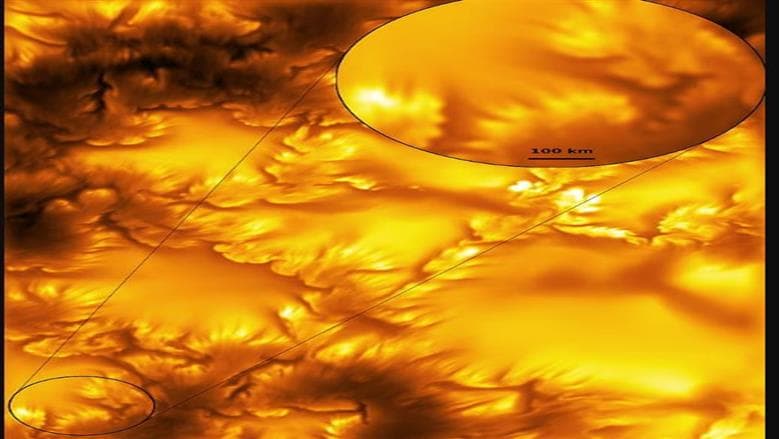
A team of scientists successfully used the "NSF Inouye" solar telescope in Hawaii—the most powerful solar telescope ever built—to capture the highest-resolution images and videos of the Sun's surface, revealing unprecedented details. The images showed a turbulent magnetic region at the edge of a cool sunspot, where for the first time, the phenomenon known as "Kelvin-Helmholtz Instability" (KHI) was directly observed. This phenomenon involves small-scale plasma vortices that form when two layers of fluids or gases move at different speeds. This discovery represents an important step toward understanding the Sun's violent phenomena, such as solar flares and coronal mass ejections, which impact Earth by disrupting satellites, communication networks, and power systems. The study indicated that these vortices, resulting from the interaction of magnetic field structures and differences in the velocities of plasma layers, may be responsible for twisting magnetic field lines and accumulating energy that eventually leads to massive solar eruptions. Additionally, this could explain why the Sun's corona reaches temperatures exceeding a million Kelvin despite its surface being cooler. This breakthrough is among the most significant advancements in understanding solar plasma dynamics and underscores the need for ongoing research to better understand how these phenomena form and influence the Earth's climate.
Notice: This Is an AI-Generated Summary
Comments (0)