43 Days_1777292798912_197359786.jpg&w=48&q=75)
Source:
عكس السير
عكس السير
Ready to play
Ready to play
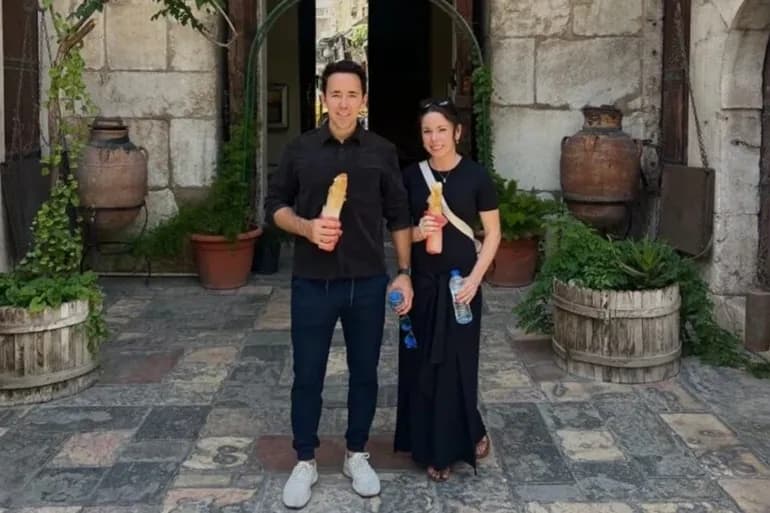
Seven years have passed since I was falsely arrested and held hostage in the Syrian regime's prisons. Today, I have returned to Damascus with my wife Natasha and our unborn daughter. This is how American activist and writer Sam Goodwin began a recently published article, sharing his painful experience in Syria, which he visited as part of his long journey to see every country in the world. Goodwin states that “one of the most common questions I receive after giving keynote speeches is whether I will ever return to Syria. Usually, the question is asked with a mix of curiosity and disbelief. I have always given the same answer... maybe I will return someday. And here is that day.” He adds: “In 2019, during the final phase of a decade-long journey to visit every country in the world, the Assad regime arrested me on false charges of being an American spy. I was detained for nine weeks, without knowing if I would ever be released.” The American writer affirms that he only learned the full story of what happened to him after returning home. “That’s when I learned what my family, friends, government officials, journalists, even Vatican leaders, and countless others had done to help free me,” he explains. Goodwin also notes that his bitter experience forced him to choose either to be defined by it or to move beyond it and continue his life. After regaining his freedom, he completed his journey, finished visiting 193 countries, and earned a master’s and doctorate degrees focusing on the conflict in Syria. He also published memoirs entitled “Saving Sam.” During the United Nations General Assembly meetings last September, Goodwin met Syrian President Ahmad al-Shar‘a, spending 45 minutes with him. During their meeting, al-Shar‘a invited Goodwin to return to Damascus. While in detention in Syria, Goodwin met exceptional men— as he describes them—some of whom shared their food with him in the cell when he had nothing to eat, helped him get eyeglasses after his contact lenses expired, and some risked punishment to pass information about him between prisoners. He also recounts that one of them helped smuggle a letter abroad. He states that visiting Syria again “gave me the opportunity to meet many of these people and thank them for what they did for me.” Goodwin entered Syria from Iraq in 2019 and stayed in Qamishli, a city on the border with Turkey, then controlled by the Syrian Democratic Forces, except for the city center or “security zone,” which was under Assad’s control. He was detained by “men in military uniforms” near the hotel where he was staying, while he was on a FaceTime call with his mother in the United States. He recounts being taken to a basement in what he later learned was called the 215 Branch of the Syrian Military Intelligence. He was placed in a solitary cell for 27 days of his 63 days of detention. His only daily human interaction was a few seconds in the mornings and evenings when guards brought him water, bread, and boiled potatoes. His lawyers say he was tortured during his detention, and that he faced lengthy interrogations, one of which included a threat from the investigator to hand him over to ISIS if he insisted on denying the espionage charges. American media reported that Goodwin and those close to him said efforts for his release were mediated by Lebanese General Abbas Ibrahim, director of Lebanon’s General Security, with whom Goodwin’s family contacted. Additionally, efforts involved the FBI, the CIA, Vatican representatives, Middle East experts, and others, though details about how or under what conditions the Syrian regime agreed to his release were not published. In May 2025, a court ruling awarded Goodwin nearly $20 million as compensation for what he went through, following a lawsuit filed under a special legal exemption related to countries classified by the U.S. as state sponsors of terrorism, under the Foreign Sovereign Immunities Act. About half of this compensation will be paid from the U.S.-sponsored Terror Victims Fund, financed by sanctions and fines, with Goodwin potentially receiving a percentage of the remaining half over several years. A lawyer from the firm representing Goodwin commented on the ruling, saying, “Countries that violate international human rights standards must face consequences. Brave survivors like Sam help ensure that the atrocities committed by the Assad regime are not ignored by the world.” Goodwin also explained that “this court ruling is about more than just my personal experience. It’s a show of solidarity with all those who have suffered human rights abuses worldwide. I hope it encourages other victims to speak out and serves as a warning that such crimes will neither be tolerated nor forgotten.” In his article, Goodwin mentions that when he wrote “Saving Sam,” he used pseudonyms for those who assisted him in his ordeal to protect them. He describes how happiness overwhelmed him upon returning to Syria and sitting with them in Damascus, sharing laughter over the aliases he had given them. He added: “This journey took me to places I never imagined I’d see again. I visited the prisons where I was held, the court where my future decisions were made, and met members of the new Syrian parliament working to rebuild their country.” He continued: “Syria itself has changed too. When I left in 2019, I had lost about five kilograms. Now, after this visit, I feel I returned to the United States with five extra kilos, thanks to the warmth and hospitality of the Syrians.” Goodwin also recalls another moment that stayed with him: one reason he entered Syria on that Saturday in 2019 was to attend a Sunday mass. His arrest prevented him from doing so. “Today, after seven years, my wife Natasha and I attended mass at St. Paul’s Church in Old Damascus,” he says. People ask him if he holds a grudge against Syria, and he responds: “I harbor no resentment for what happened to me. Not against the country or its people—the country isn’t its government, and the people aren’t its policies. My return to Syria is not about forgetting the past or proving anything to anyone. It’s about refusing to let fear write the final chapter of my story.” Goodwin concludes: “Seven years ago, I wasn’t sure if I would ever live the life I hoped for. But this year, I returned to Syria with the woman I love and the daughter we’re expecting soon, grateful for the simple reminder that none of us can get through life’s hardest moments alone. Prisons still exist, memories remain, but the final word is no longer hostage to fear or uncertainty.”
Notice: This Is an AI-Generated Summary


Comments (0)